About 20 minutes up the road from Nakoma, a single rope tow now runs along the old Rainbow Poma line at the Johnsville Historic Ski Bowl. It was the Plumas Ski Club's first working lift in more than two decades. The club planned only a handful of Saturdays on it, and each one depended on snow reaching Intorf Lodge. Nakoma's own winter page calls the historic ski area "not currently operating" and points visitors there for snowshoeing and sledding. Both descriptions fit a hill that opens only when a volunteer club, a permit and the weather all line up, and that is how winter works in this corner of the Lost Sierra.
Most of what you can do in the snow here, other than at the resort itself, depends on a nonprofit, a volunteer crew or a donation box. All of it depends on the snow line.
Twenty-Four Years Without a Lift
The Plumas Ski Club has run the ski bowl above Johnsville since 1955. That was before the land became Plumas-Eureka State Park in 1959. Early on, the hill had as many as four rope tows. By 1975 it had two Poma lifts, and they ran until 2001. After lift and lodge operations stopped, the bowl stayed open to backcountry skiers, snowboarders, sledders and cross-country skiers, but nothing carried anyone uphill.
The history goes deeper than most Tahoe resorts can claim. According to the club, by 1863 Gold Mountain, now called Eureka Peak, had a ski run with 2,600 feet of vertical above the mining town of Johnsville. The club calls the area the birthplace of ski racing and sport skiing in the Americas.
Getting a lift running again took more than a decade. The Plumas Sun reported that in 2013 the club bought the two-person Mainline chairlift from Palisades Tahoe with limited grant money. Installing it turned out to be too hard. Instead, the club restored the chairs and auctioned them in 2023 and 2024, raising $60,000. Proceeds from the Historic Longboard Revival Series added about $40,000. That money bought and installed the rope tow, which club president Greg Hinds called the only affordable lift option for a small organization.
The tow was tested on March 22, 2025, using posts from the old Rainbow Poma. The motor sits at the top of the Bunny Hill.
What Has to Happen Before It Runs
Having a working lift and having an open ski day are two separate things at Johnsville. Before anyone grabs the rope, several things have to line up, according to the Plumas Sun's reporting:
- The annual inspection. The Amusement Ride and Tramway Unit of the California Division of Occupational Safety and Health has to inspect and approve the rope tow every season. Each inspection costs about $1,000.
- Insurance. The club has to be able to cover liability insurance for running the tow. For the 2026 season, vice president Don Fregulia said it could.
- A special-use permit. The club does not have an ongoing ski-hill operating agreement with California State Parks. It holds community ski days under special-use permits.
- Volunteers. Fregulia said the club needs volunteers to staff those days.
- Snow at the right elevation. Snow has to reach the base of the hill at Intorf Lodge.
Under that model, the club planned three Saturday community ski days for last winter, on January 31, February 28 and March 28, 2026, each from 10 a.m. to 4 p.m., with food and drinks available.
Snow is the one requirement the club can't arrange. Hinds told the Plumas Sun that the tow was tested in March 2025, but for most of the winter before that, the snow level sat higher than Intorf Lodge. He said the average snow level seems to rise every year, which limits how many days the bowl can open, and he called it possibly the main obstacle to fully reopening.
So the question that matters for a day at Johnsville is whether snow has reached the lodge. Days on the calendar come second.
The Same Dependency, Everywhere Off the Resort
Look past the ski bowl and the same pattern repeats. Nakoma runs its own winter amenities. Almost everything else nearby is run by volunteers, kept up by donations or open only when snow conditions allow.
| Where | Who runs it | What it depends on |
|---|---|---|
| Nakoma's cross-country loop around the golf course | Nakoma | Snowfall; 2.5 km groomed when snow allows |
| Nakoma tubing hill and snowshoeing | Nakoma; tube, helmet and snowshoe rentals at Altitude | Snow cover on the groomed hill and course |
| Nakoma fat-tire bikes | Nakoma, for members and Inn at Nakoma guests | Snow-covered terrain around the resort |
| Plumas-Eureka State Park ski and snowshoe trails | Plumas-Eureka State Park Association volunteers | Fresh snow, volunteer availability and donations |
| Johnsville rope tow | Plumas Ski Club | Inspection, insurance, permit, volunteers, snow at Intorf Lodge |
| Historic Longboard Revival races | Plumas Ski Club volunteers | Enough snow on race day |
| Snowmobile tours near Lake Davis | Sierra Touring Company | Two- and three-hour guided tours; drivers must be 16 with a valid license |
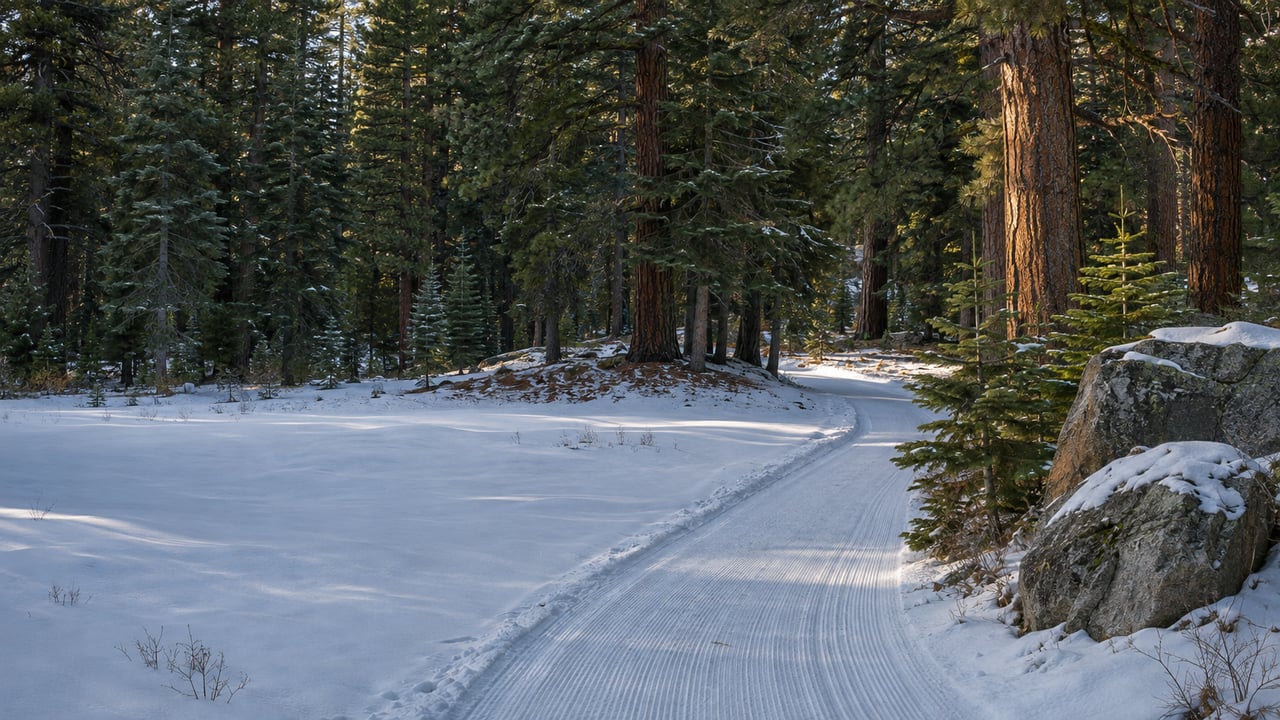
The park trails are the clearest example after the ski bowl. They sit about 20 minutes from Nakoma, depending on road conditions. Nakoma's winter page says the trails are usually groomed after new snow and depend on whether volunteers are available. The Plumas-Eureka State Park Association does the grooming. It encourages but does not require donations. Suggested amounts are $12 per adult and $7 per youth for a day, or $80 per adult and $125 per family for the season. On the association's model, those donations are what keep the trail system groomed through the winter.
Some winter outings need no groomer at all. The snowshoe route to Eureka Lake is about 1.25 miles. It crosses an old ski hill and wraps around the back of the mountain to the lake. Strong hikers can keep going to Eureka Peak at 7,400 feet, where clear days show Mount Lassen and the Sierra Buttes. About nine miles from Nakoma, Gold Lake Highway goes unplowed in winter. A winter non-motorized trail starts about 1.5 miles up Gold Lake Road and ends at Gray Eagle Lodge Road.
Sledding at Johnsville doesn't need the tow either. The area around Intorf Lodge is a popular sledding spot, thanks to the Plumas Ski Club's work keeping up the vegetation and infrastructure at the bowl. Nakoma's winter page adds that the walk from the parking lot to the hill makes a good short snowshoe for kids.
The Races That Paid for the Tow
The Historic Longboard Revival Series shows how the whole system works. The races began at the ski bowl in 1993. Volunteers run them, Hinds coordinates them, and they raised the $40,000 that went into the rope tow. They have also been canceled four times in two decades, in 2007, 2014 and 2015 for lack of snow and in 2021 because of COVID.
The 2027 series is set for January 17, February 21 and March 21 at the Johnsville Historic Ski Bowl, all weather permitting. Race days follow a fixed schedule:
- 10 to 11:15 a.m. Registration
- 11:45 a.m. Number drawing
- Noon Racing
Racers wear 1860s-style clothing, ride wooden skis 9 to 16 feet long, wear leather boots and use authentic "dope" wax. Fees are a $20 Plumas Ski Club membership, plus either a $20 race fee for members on their own skis or $20 to use club longboards. The club's race page says club longboards are limited and rented first-come, first-served.
The competition is real. Hinds has won three championships in the past four years, and the 2025 podiums included racers known as "Slick Bottom," "Kamikaze" and "Hot Knife Thru Butter."
Holiday Dates That Don't Need Snow
Until the snow line comes down, the season's fixed dates are indoors or in town. Nakoma's dining room has already switched to its cold-weather schedule. FIFTY44 is open to the public Thursday through Sunday, 4 to 8 p.m., for fall and winter. The winter dinner menu leans toward game, with elk meatballs, a hunter's bolognese made with elk and bison, braised short rib ragu, and pappardelle frutti di mare.
Here are the dates from now through the end of the year:
- Thursday, November 26. Thanksgiving at FIFTY44, 1 to 5 p.m., $100 per person and free for children under 2. Choices include turkey, prime rib or stuffed delicata squash, and Chef Matthew Crawford is named on the prix fixe. The restaurant is taking reservations.
- Friday, December 4. Portola City Tree Lighting at Main Park.
- Saturday, December 5. Graeagle Holiday Festival downtown, 1 to 5 p.m., with a tree lighting, Santa, carolers, refreshments and decorated trolley rides. All events are free.
- December 5, 11, 12, 18 and 19. Santa Trains at the Western Pacific Railroad Museum in Portola. Gates open at 4 p.m. and rides start at 5 p.m.
The Santa Trains are the only time this winter to visit the museum, which is otherwise closed except for special events. The yard looks a little different this year. WP 707 returned to service on September 7, 2026, and CB&Q 4720, the Silver Rifle, left on September 1 for its new home at the Colorado Railroad Museum.
After December 19, the next fixed date is the first longboard race on January 17, weather permitting. Johnsville's rope tow, the park's groomed trails and Nakoma's own loop around the golf course will all open when the snow arrives.
At Team Blair Tahoe, we follow the Lost Sierra season by season, from the ski bowl above Johnsville to Nakoma itself. If you own near Nakoma and want to know how your property fits into this part of Plumas County, we would be glad to prepare a Private Market Valuation for you.
 Explore Additional Insights and Articles